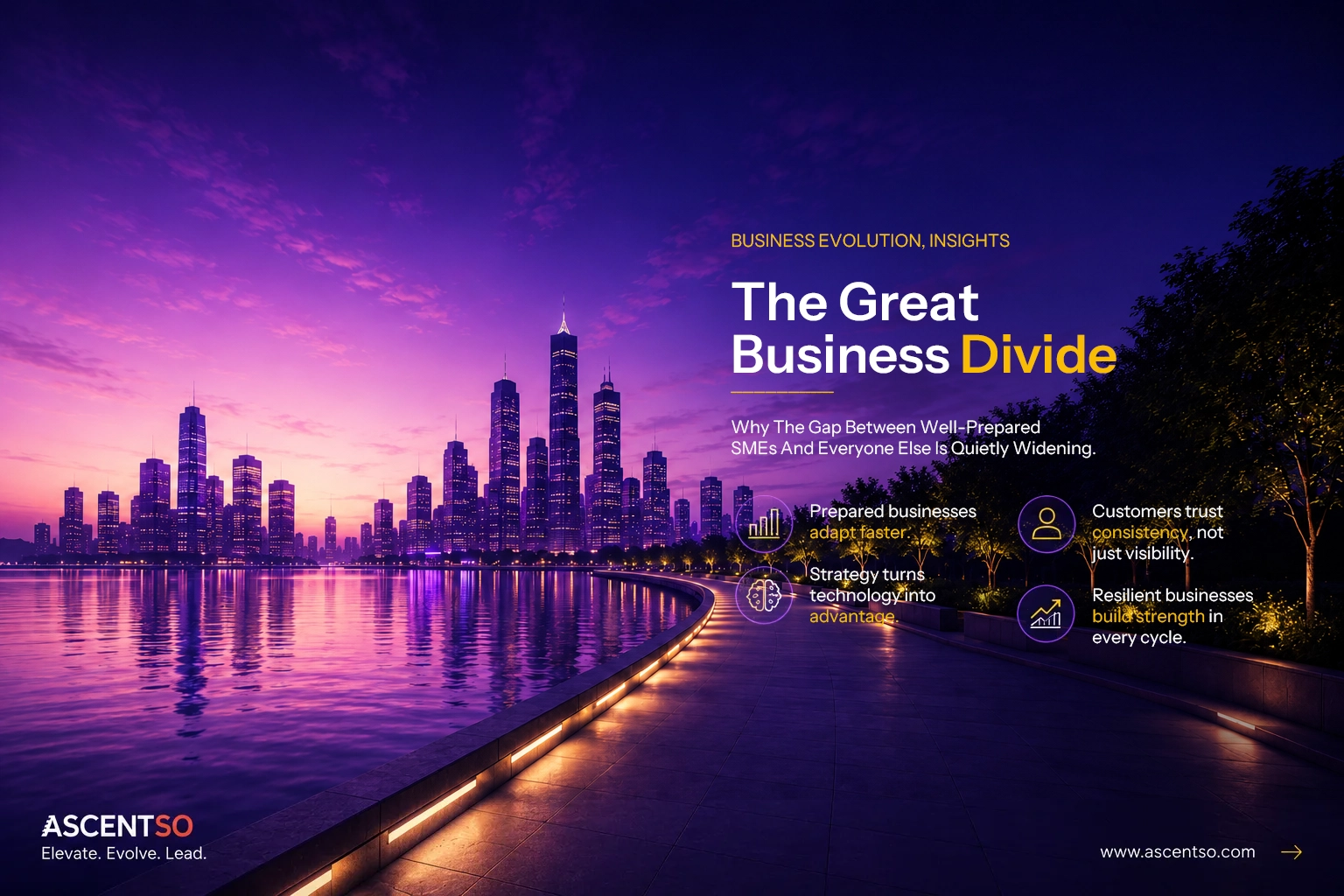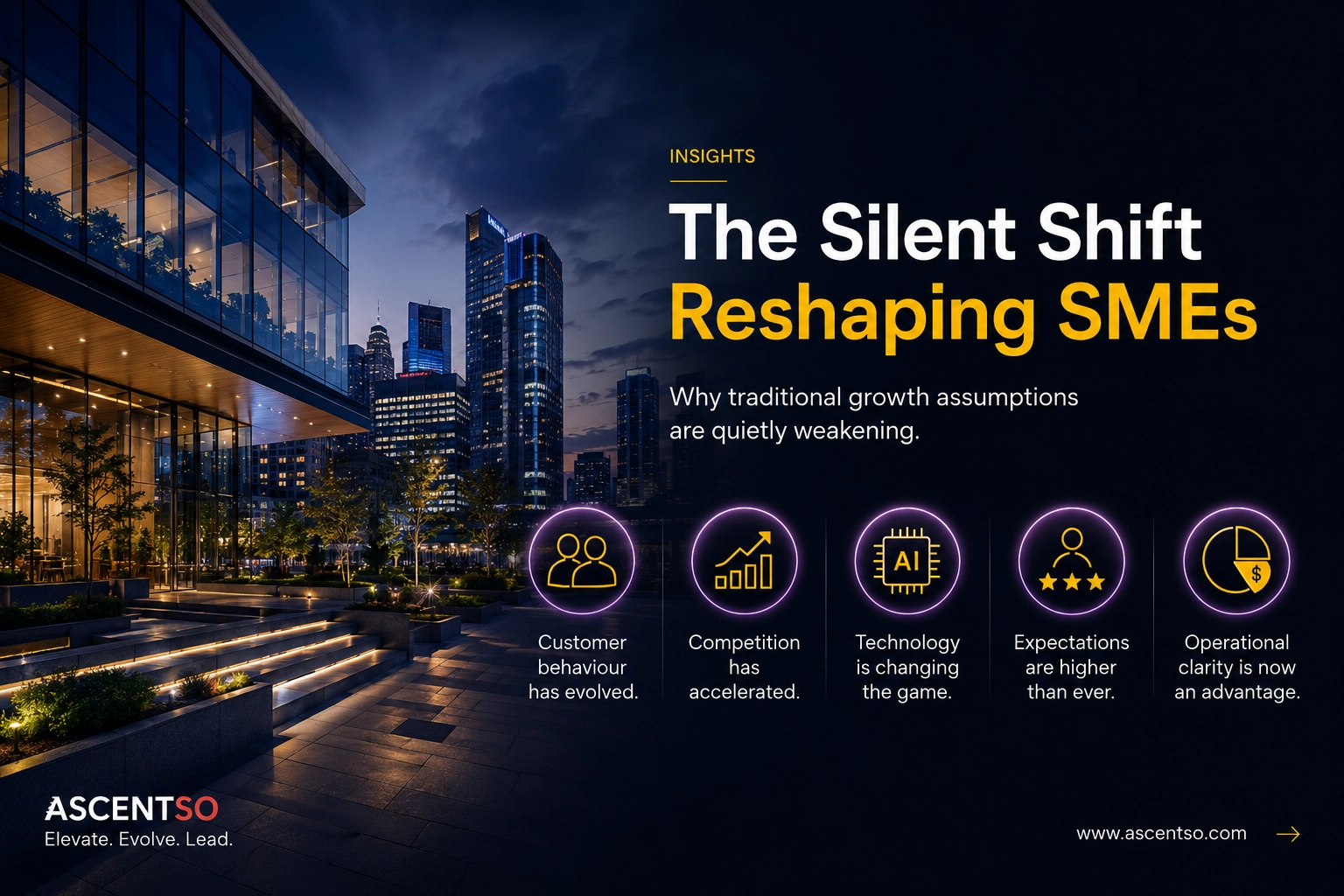
Why Traditional Growth Assumptions Are Quietly Weakening
For many SMEs, the pressure feels increasingly familiar.
Businesses are still operating.
Teams are still working hard.
Marketing activities continue.
Sales efforts remain active.
Yet despite the activity, many businesses are experiencing:
- slower growth momentum
- longer customer decision cycles
- increasing price sensitivity
- rising operational pressure
- intensifying competition
For some, it feels confusing.
Because the strategies that once worked reasonably well no longer seem to produce the same outcomes.
This is not merely a temporary slowdown.
A broader structural shift is happening across the business landscape — quietly, but significantly.
The Market Environment Has Fundamentally Changed
Many SMEs today are still operating based on assumptions formed in a very different business environment.
An environment where:
- customer attention was less fragmented
- digital competition was relatively limited
- visibility itself created advantage
- operational complexity was lower
- barriers to entry were harder to overcome
That environment no longer exists.
Today’s market behaves differently.
Customers compare more extensively.
Attention spans are shorter.
Digital competition enters faster.
AI accelerates execution.
Expectations continue rising.
As a result, businesses are now competing in markets that move faster, evaluate harder, and tolerate less friction.
The Fragmentation Of Customer Attention
One of the biggest shifts affecting SMEs today is the fragmentation of customer attention.
Modern customers are exposed to:
- endless advertising
- constant promotions
- algorithm-driven content
- multiple competing platforms
- unlimited alternatives
The result is not merely “less attention.”
It is selective attention.
Customers are becoming more cautious with:
- spending
- trust
- time
- engagement
Visibility alone is no longer enough to sustain meaningful competitive advantage.
Businesses now need to earn:
- relevance
- credibility
- consistency
- trust
repeatedly.
Digital Competition Has Accelerated Dramatically
Digital barriers have lowered significantly.
Today, almost anyone can:
- launch an online business
- run advertisements
- build websites
- generate AI-assisted content
- automate communication
- enter new markets rapidly
This creates an environment where activity becomes easier —
but differentiation becomes harder.
In increasingly saturated markets, generic businesses become easier to ignore.
The challenge is no longer simply:
“How do we become visible?”
The more important question is:
“Why should customers choose us specifically?”
This shift changes the role of business strategy entirely.
Visibility Without Trust Is Becoming Fragile
Many businesses still approach growth primarily through:
- promotions
- advertising
- content volume
- short-term visibility tactics
However, modern customers increasingly evaluate businesses through:
- reviews
- responsiveness
- operational consistency
- perceived competence
- digital credibility
- customer experience
As a result, visibility without trust often produces fragile growth.
A business may attract attention —
yet still struggle with:
- conversion quality
- retention
- long-term loyalty
- sustainable momentum
In today’s environment, trust is becoming infrastructure.
Not merely branding.
AI Is Accelerating Operational Gaps
Artificial intelligence is reshaping business rapidly.
However, AI itself is not the real issue.
The more significant shift is:
the widening operational gap between businesses that adapt intelligently and those that remain operationally fragmented.
AI can improve:
- speed
- accessibility
- automation
- efficiency
- output generation
But technology alone does not automatically create:
- strategic clarity
- operational coherence
- customer trust
- differentiation
- long-term resilience
As AI lowers execution barriers, businesses operating without clear positioning or coherent systems may become increasingly replaceable.
The businesses likely to benefit most from AI are not necessarily those using the most tools.
They are often the businesses integrating technology with:
- strategic thinking
- operational maturity
- clearer systems
- better decision-making structures
Operational Clarity Is Becoming Competitive Advantage
Many SMEs assume growth challenges are primarily caused by:
- insufficient marketing
- weak sales
- low visibility
But increasingly, another issue exists beneath the surface:
Operational fragmentation.
Disconnected workflows.
Scattered customer communication.
Manual dependency.
Inconsistent processes.
Reactive decision-making.
As markets become more complex, operational clarity is no longer merely an internal management concern.
It is becoming a competitive advantage.
Businesses with:
- clearer systems
- better information flow
- stronger operational visibility
- integrated digital processes
are often able to:
- respond faster
- scale more sustainably
- improve customer experience
- reduce operational friction
- make clearer decisions
In contrast, fragmented businesses often experience:
high activity,
but inconsistent momentum.
In increasingly competitive markets, clarity compounds.
The Businesses Likely To Adapt Better
The next generation of resilient SMEs may not necessarily be:
- the loudest
- the fastest growing
- the most visible
Instead, they may be the businesses that become:
- more coherent
- more adaptable
- more operationally disciplined
- more strategically focused
- more digitally integrated
Because sustainable business evolution rarely comes from isolated tactics alone.
It usually comes from alignment between:
- strategy
- operations
- positioning
- systems
- customer experience
- long-term direction
Final Reflection
Economic cycles will continue to fluctuate.
Technology will continue evolving.
Competition will continue accelerating.
The businesses that adapt strongest may not simply be those doing more.
They may be the businesses developing:
greater clarity,
stronger operational foundations,
and more intelligent ways of evolving within changing markets.
Because while economic conditions may change repeatedly,
business evolution does not pause.
© 2026 Ascentso. All rights reserved.
Strategic insights for evolving businesses.
🌐 www.ascentso.com