Understanding Why It Exists — and Why It Still Matters
Originally published 2024 | Updated for 2025
“Do SEO.” A phrase repeated so often it’s lost all meaning.
Ask ten people and you’ll get ten answers:
“It’s keywords.”
“It’s ranking.”
“It’s blog posts.”
“It’s meta tags.”
Or my favourite — “Just make a Facebook page.”
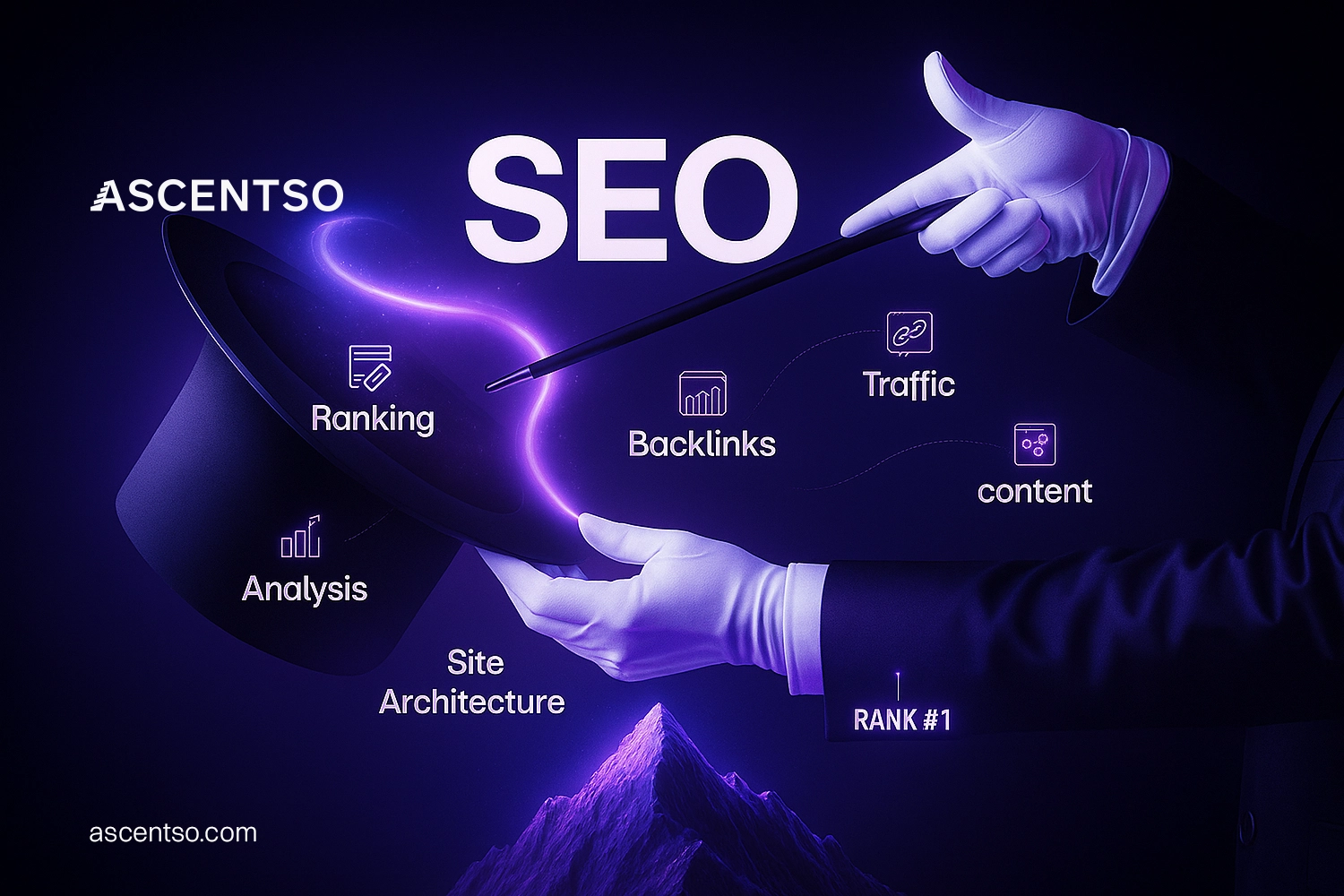
In truth, SEO isn’t a checklist. It’s the architecture of digital visibility — how search engines interpret who you are, what you offer, and why you matter.
Before SEO: The Internet and Your Digital Foundation
Before we talk about visibility, we need to talk about ownership.
Your website isn’t a brochure — it’s your business’s digital premises. The only space you truly own online. When designed strategically, it becomes a 24/7 system that:
- Attracts traffic (visibility)
- Converts visitors (performance)
- Collects intelligence (growth)
SEO exists to ensure that foundation is discoverable, understandable, and trusted — by both humans and machines.
Why SEO Exists
When the Internet exploded in the 1990s, it was digital chaos. Search engines like AltaVista, Yahoo!, and later Google brought order. PageRank changed the game — measuring trust through links.
From then on, SEO became the translator between humans and algorithms — a way to make your message legible to machines and valuable to people.
Without it, even the best website is just a digital island — beautiful, but invisible.
When SEO Was Mechanical
In 2010, there were around 255 million websites. Today, there are over roughly 1.2 billion — a nearly five-fold increase.
Back then, SEO followed a simple pyramid:
- Crawlability — Let Google read your site.
- Content — Be relevant.
- On-Page SEO — Organise your signals.
- Off-Page SEO — Earn backlinks.
- User Experience — Keep visitors engaged.
That worked when the web was a library of pages. Now it’s an ecosystem of systems — dynamic, interconnected, and fiercely competitive.
“When the web was smaller, ranking was simple. Now your site competes with a billion signals and a few seconds of attention.”
From Search to Understanding
Modern search engines don’t just read — they reason. They interpret meaning, relationships, and intent.
This is why SEO evolved into AEO (Answer Engine Optimization) and GEO (Generative Engine Optimization). It’s no longer about feeding keywords. It’s about feeding understanding.
Leaders should focus on:
- Semantic clarity — How well your content speaks the language of context.
- Technical health — Speed, security, and mobile-first readiness.
- Authority ecosystems — Not just backlinks, but reputation and relevance.
Go deeper: Beyond Keywords — The New Layers of SEO in the Age of AI Search (SEO + AEO + GEO)
Why SEO Still Matters in the AI Era
Even as AI search reshapes discovery, SEO remains the silent engine behind trust.
- Visibility still starts with structure. Even AI assistants pull from indexed data. No SEO = no visibility.
- It compounds over time. Ads stop when budgets stop. SEO builds equity.
- It fuels AI discoverability. Structured, verifiable sites are what large models trust.
- It governs your digital truth. SEO ensures algorithms represent your brand accurately — it’s digital governance as much as marketing.
Why Founders and Leaders Must Care
SEO is no longer a technical task — it’s strategic infrastructure. It shapes how your brand is perceived, how decisions are made, and how your digital assets appreciate over time.
- Build with data, not vanity.
- Choose sustainable partners, not shortcuts.
- Treat SEO as a system, not a service.
“Visibility without credibility is temporary. Visibility with trust is brand equity.”
Final Thought
The Internet has grown from 255 million to over a billion sites, but one truth remains: clarity wins.
At Ascentso, we see SEO not as marketing — but as architecture. It’s how we engineer digital assets that perform, adapt, and endure.